Otto Dix
Biography
“No, artists should not seek to reform or convert.
They are far too insignificant. They must simply bear witness.” (1958)
1891–1910 | Youth in Eastern Thuringia
1891 Born on 2 December in Untermhaus near Gera (Thuringia), the second child of iron moulder Franz and seamstress Louise Dix. Grew up with three siblings in modest but not impoverished circumstances. His father and brother were committed Social Democrats.
1898–1906 Attended primary school in Untermhaus. Received his first artistic encouragement from art teacher Ernst Schunke.
1906–1910 Apprenticeship as a decorative painter with Carl Senff in Gera. In the summer of 1910, worked as a journeyman in Pößneck, Thuringia.
1910–1914 | At the School of Applied Arts in Dresden
From September 1910 to August 1914, attended the Grand Ducal Saxon School of Applied Arts in Dresden. Pupil of Max Rade and Richard Mebert (ornamental and landscape painting) as well as Johannes Türk (figure drawing). From 1912, trained in figurative decorative painting under the painter and sculptor Richard Guhr. Formed friendships with fellow students Otto Baumgärtel, Marga Kummer, Kurt Lohse and Otto Griebel.
1912/13: Hiking tour through Bohemia and Moravia, as well as two study trips to Austria and Italy.
1912–1914: Engagement with the Old Masters in the Picture Gallery. Initial artistic experiences at exhibitions in the avant-garde galleries Arnold and Richter (van Gogh, February 1912; New Expressionist Painting, January 1914). A phase of stylistic pluralism, primarily self-portraits. Enthusiasm for the philosophy of Friedrich Nietzsche.
1914–1918 | During the First World War
Drafted as a reserve soldier in August 1914. Trained on heavy machine guns; stationed in Bautzen from February 1915. Volunteered for the front in September 1915. Served until December 1918 as a machine-gunner and platoon leader in Champagne, on the Somme, in Artois and in Flanders, as well as on the Eastern Front in 1917. Dix is one of the few German artists to have experienced the First World War almost without interruption on the front line as a fateful ‘natural phenomenon’.
1916 Awarded the Iron Cross, Second Class. 1918 Wounded and promoted to the rank of sergeant.
Extensive collection of realistic, expressionist, cubo-futurist and abstract drawings in pencil, chalk and ink, alongside gouaches.
1919–1923 | Artistic struggles in Dresden and Düsseldorf
1919 Return to Dresden. Studied at the State Academy of Fine Arts until 1922. A master student of Max Feldbauer and Otto Gußmann.
1919 Co-founder of the “Dresden Secession – Group 1919”. Participation in spectacular exhibitions in Dresden, Düsseldorf, Prague and Berlin (1st International Dada Exhibition at the Berlin Galerie Burchard, summer 1920).
Friendship with Conrad Felixmüller, who introduced Dix to the technique of etching in 1920.
Connections to the Berlin Dadaists George Grosz and John Heartfield. First contacts with the Düsseldorf avant-garde group “Junges Rheinland”.
1919/20 Development of a novel, polemically sharpened realism with socially critical potency. Dix succeeds as the “notorious” protagonist of this movement known as Verismus.
1924–1933 | At the zenith – Berlin and Dresden
1924: definitive breakthrough as a recognised artist of the German contemporary scene. The Berlin art dealer Karl Nierendorf publishes the War Cycle and subsequently takes on the business representation of Dix. A first monograph of his works, with an introduction by Willi Wolfradt, is published in the “Junge Kunst” series by Klinkhardt & Biermann. Participation in the “1st German Art Exhibition” in Moscow, Saratov and Leningrad with 13 works. Collaboration on the portfolios “War” and “Hunger” for the International Workers’ Aid. Late 1924: successful solo exhibition (watercolours and drawings) at the Kronprinzenpalais in Berlin.
November 1925: moved to Berlin, living at Kaiserdamm 20; from 1926, studio at Kurfürstendamm 190. Made acquaintances in the intellectual and artistic circles of the Romanisches Café.
1925/26: Participated in the programmatic exhibition “New Objectivity” in Mannheim and in the “International Art Exhibition 1926” in Dresden.
1933–1945 | Internal exile on Lake Constance
April 1933: one of the first artists to be dismissed from teaching during the Nazi era for “offending public decency and undermining the German people’s will to defend the nation”. Autumn 1933: first public defamation as a “degenerate” artist in an exhibition in the atrium of Dresden Town Hall. From 1934: banned from exhibiting in Dresden. In 1937/38, eight major works were the focus of the travelling exhibition “Degenerate Art”. During Nazi purges, a total of around 260 works by Dix were confiscated from German museums.
From summer 1933, “internal exile” in south-west Germany: initially at Randegg Castle in Hegau, from 1936 in Hemmenhofen on Lake Constance (his main residence until his death in 1969). Annual visits to Dresden until 1943 (studio: Kesselsdorfer Straße 11). There, at the end of 1938, he was detained by the Gestapo for a fortnight following the assassination attempt on Hitler at the Hofbräuhaus in Munich.
1946–1969 | Between two “Germanies”
February 1946: Return to Hemmenhofen.
His expressive late work is dominated by primal painting and lithography.
From 1947 to 1966, annual working stays in Dresden (printing of lithographs). Dix becomes an exemplary German-German artist and finds himself caught between the fronts of Western-influenced post-war abstract modernism and Socialist Realism in the GDR.
1955 Participation in documenta I in Kassel; member of the Academy of Arts, Berlin-Dahlem. 1956 Corresponding member of the German Academy of Arts, Berlin (East). 1957 Extensive retrospective at the Academy of Arts, Berlin (East). 1960 First edition of the monograph by Fritz Löffler (Dresden), which remains fundamental to this day.
Works:
1910–1914 | Early works
The early works were created during his studies at the Dresden School of Applied Arts from September 1910 until his conscription in August 1914. The powerful late Impressionism of Gera and Dresden landscape motifs was replaced in 1912 by a stylistically pluralistic phase. Until 1915, self-portraits and portraits of friends in particular provided the occasion for the adaptation and transformation of artistic experiences that the artist absorbed in Dresden’s Gallery of Old Masters and in avant-garde galleries: from Dürer via Klinger and van Gogh to Futurism. Inspired by an enthusiasm for the philosophy of Friedrich Nietzsche, his only sculptural work was created in the spring of 1914. The vitalist concept of the eternal cycle between birth and death is reflected in 1913–14 primarily in expressionist ink drawings featuring erotic, Christian and mythological subjects. The early work reveals for the first time the stylistic syncretism characteristic of Dix and the fundamental theme of his life’s work: the dialectic of Eros and death.
1914–1918 | World War
Dix is one of the few German artists to experience the First World War from 1915 to December 1918 on the front line as a ‘natural phenomenon’, and in doing so formulates his self-understanding: ‘The artist: one who has the courage to say yes.’ [War Diary, 1915/16] Alongside nearly 500 drawings, the catalogues raisonnés by Löffler and Pfäffle list merely five paintings and 86 gouaches. Dix successively explores all the creative possibilities of modernism on sheets of packing paper the size of a knapsack, using pencil, black chalk and ink: from realistic exploration of objects through expressionist distortion of form and Cubo-Futurist decomposition of objects to an abstract apocalyptic vision. The focus of the range of motifs is less on everyday military life and more on the bizarre war aesthetics of the landscape of rubble, craters and trenches. In contrast to the veristic polemic of his later war compositions, the machine-gunner seeks to ‘banish’ the horror through style.
1919–1923 | Expressionism – Dadaism – Verism
After the First World War, Dix emerged as the enfant terrible of the German art scene in Dresden, and from 1922 onwards in Düsseldorf. The painter initially revisited pre-war themes using Expressionist formulas of pathos, and shortly afterwards processed his post-war insights through Dadaist scenarios of war-wounded soldiers and brothels. The draughtsman, on the other hand, practised capturing reality in a succinct manner.
In this way, he found ‘his’ style. ‘The Expressionists had made enough art. We wanted to see reality completely naked, clearly, almost without art.’ (1965) In 1920–21, Dix emerged as the protagonist of a new kind of brutal realism with socially critical potency and political explosiveness. From anti-bourgeois stylistic attitudes, realistic pictorial formulas of aggressive sharpness crystallise, which contemporary critics describe as ‘Verismus’ (P. Westheim) and situate on the ‘left wing’ of New Objectivity (G. F. Hartlaub). With the etching cycle “The War”, Dix reached the pinnacle of his early graphic oeuvre in 1924.
1924–1933 | New Objectivity
In 1924, a paradigm shift became apparent. Expressive Verism took on coolly observant traits and an affirmative tendency through a turn towards the old masters’ glazing technique and neutral, incisive lines. Dix became a master of New Objectivity, the style of the stabilised Weimar Republic. Yet he never expresses his detached affirmation of society without a sense of the grotesque. Having been in Berlin since autumn 1925, and back in Dresden from 1927 as a professor at the Academy of Fine Arts, he achieves his breakthrough as a leading figure in contemporary art. His major works are now created exclusively in painting. Dix makes his mark above all as a portraitist of the Weimar bohemian and intellectual scene. Between 1927 and 1932, he devoted two triptychs with complex iconographic programmes to the central themes of war and the metropolis. Drawing, by contrast, remained committed to the individual phenomena of reality. Towards the end of the 1920s, in his search for a genuinely German art, Dix increasingly drew on the Renaissance and the early 19th century. For him, the ‘new in painting’ was ‘an intensification of the forms of expression already present at their core in the old masters. For me, at any rate, the object remains the primary concern, and form is shaped only through the object.’ (1927)
1933–1945 | Internal Exile
During the Nazi regime in Germany, Dix – who had already been dismissed from the Dresden Academy of Fine Arts in the spring of 1933 – was defamed as a ‘degenerate’ artist. He did not emigrate abroad, but instead withdrew into an ‘inner emigration’: to Lake Constance (Hemmenhofen) and into art history. These biographical catastrophes provided the impetus for large-scale, symbolic and historical paintings in oil. In 1933, a tendency towards historicism with naturalistic and eclectic accents emerged; four years later, an iconographic shift towards Christian themes took place. From 1934 onwards, Dix—who missed the city as a stimulus for his work and a subject for his paintings—began to embrace the landscape as an artistic theme. In the tradition of Romanticism, he made it a setting for inner experience.
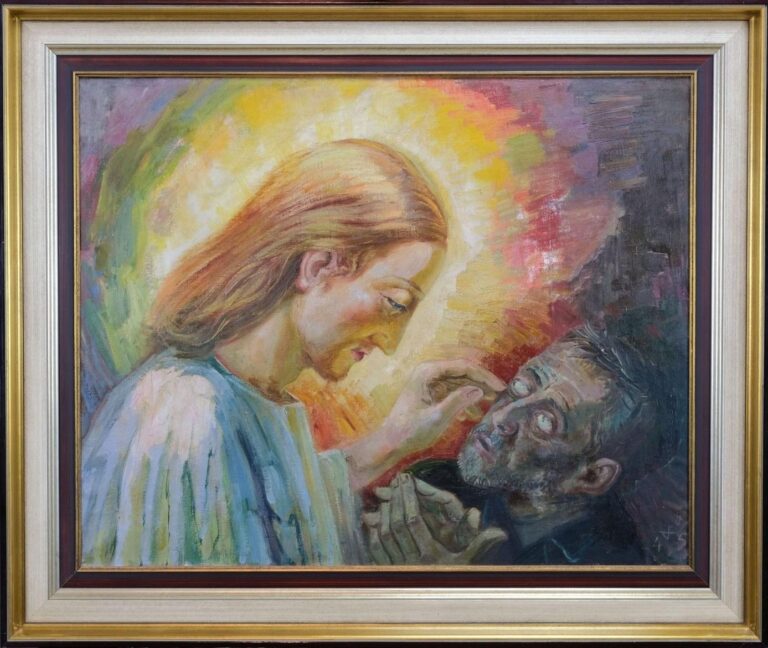
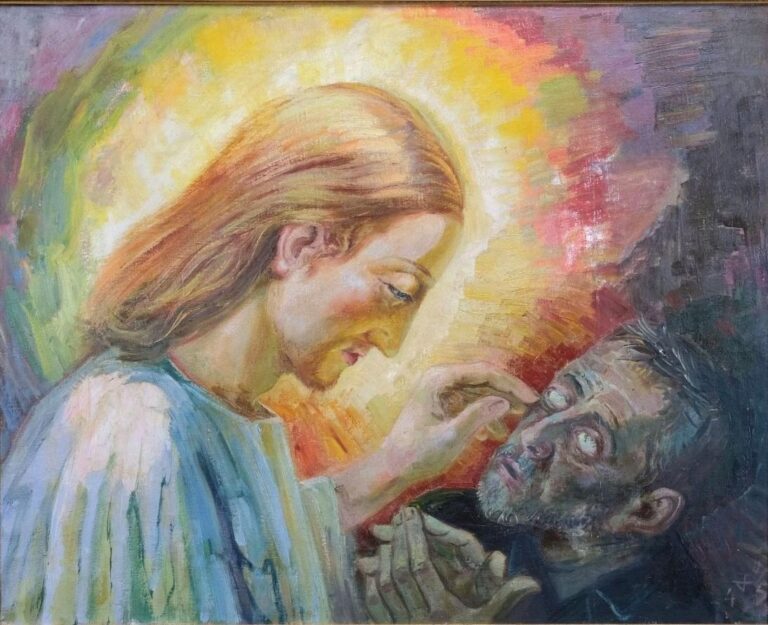
From 1937 onwards, Christian Old Master-style allegory, with more or less explicit references to the times and the self, took up an ever-greater space. Through years of work on pictorial cycles depicting archetypes such as Saints Christopher and Anthony, and finally with a Christ cycle, the artist sought to prevent his reservoir of ideas from drying up.
1946–1969 | Late Work
His late work is founded on a liberation from art-historical eclecticism. In 1944–45, Dix ‘throws the Renaissance rubbish overboard’ and turns once more to primal painting and an intensification of expressive power. This ‘new way of seeing’ erupts into explosive productivity following his time as a prisoner of war (by 1949: 150 paintings and over 200 pastels). Dix develops a neo-expressionist verism characterised by explicit clarity of message and style. In his reimagining of Christian iconography, he found contemporary symbols of guilt and atonement. The central focus of the last two decades of his life remained the (self-)portrait, alongside religious subjects and rural genres, children and animals, still lifes and landscapes. After 1948, printmaking became his preferred medium of expression. His extensive late lithographic work was produced primarily in Dresden (former GDR). Through his persistent shuttling across a national border and between two state-sanctioned art forms – “I paint neither for them nor for the others. I’m sorry.” (1963) – Dix emerged as an exemplary German-German artist.
CV
Exhibitions
- Leben – Life
- June 16, 2026 - October 25, 2026
- GMT Galerie Marc Triebold, Baselstrasse 88, CH-4125 Riehen / Basel
-
Alexander Archipenko, Otto Dix, Lyonel Feininger, Emile-Othon Friesz, Erich Heckel, Hermann Hesse, Utagawa (Ando) Hiroshige, Alexej von Jawlensky, Ernst Ludwig Kirchner, Livia und Michael Kubach und Kropp, Anna & Wolfgang Kubach-Wilmsen, Fernand Léger, August Macke, Claire Ochsner, Benno Oertli, Peter Phillips, Pablo Picasso, Paul Suter, Hans Thuar, Gil Topaz, Raymond Emile Waydelich